
Japan Shinkansen Map 2026: Bullet Train Lines & Routes
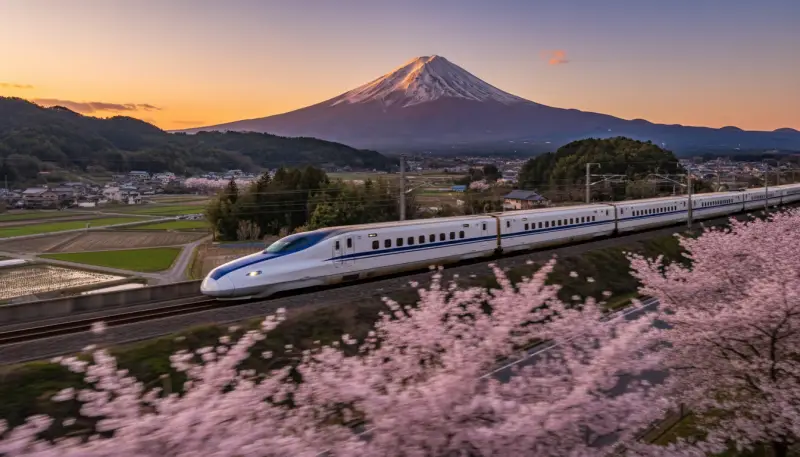
The Japan bullet train map is easier to use when you treat it as a group of connected corridors rather than one railway line. The Tokaido Shinkansen links Tokyo, Nagoya, Kyoto and Shin-Osaka. From Shin-Osaka, the Sanyo Shinkansen continues west through Okayama and Hiroshima to Hakata. Selected trains run through between the two lines, but the service name and stopping pattern still matter.
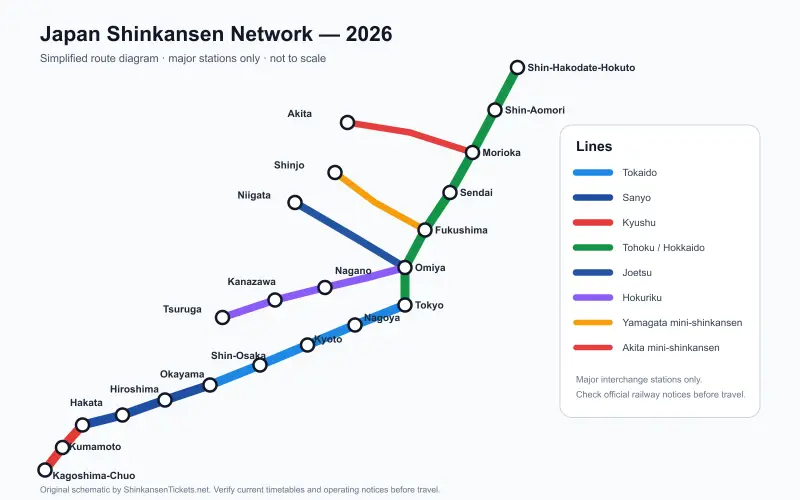
Japan Shinkansen map by line
| Line | Main corridor | Useful hubs |
|---|---|---|
| Tokaido | Tokyo–Shin-Osaka | Tokyo, Shinagawa, Nagoya, Kyoto, Shin-Osaka |
| Sanyo | Shin-Osaka–Hakata | Shin-Osaka, Okayama, Hiroshima, Hakata |
| Kyushu | Hakata–Kagoshima-Chuo | Hakata, Kumamoto, Kagoshima-Chuo |
| Tohoku | Tokyo–Shin-Aomori | Tokyo, Omiya, Sendai, Morioka, Shin-Aomori |
| Hokkaido | Shin-Aomori–Shin-Hakodate-Hokuto | Shin-Aomori, Shin-Hakodate-Hokuto |
| Joetsu | Omiya–Niigata | Omiya, Echigo-Yuzawa, Niigata |
| Hokuriku | Tokyo/Omiya–Tsuruga | Nagano, Toyama, Kanazawa, Tsuruga |
| Yamagata / Akita | Branches from the Tohoku corridor | Fukushima, Shinjo, Morioka, Akita |
How the major corridors connect
Tokyo Station is the principal interchange between the Tokaido corridor heading southwest and the Tohoku, Joetsu and Hokuriku services heading north or inland. Ueno and Omiya are useful alternatives for many northern routes. Shinagawa serves the Tokaido Shinkansen and can reduce transfers for travelers coming from southern Tokyo or Haneda Airport.
Shin-Osaka is the boundary between the Tokaido and Sanyo lines and the correct high-speed station for Osaka. Travelers staying near Osaka Station, Umeda, Namba or Universal Studios must make a local connection. Hakata is the boundary between the Sanyo and Kyushu corridors and a major gateway for Fukuoka.
Train names matter as much as line names
A line can carry several service types. On the Tokaido corridor, Nozomi makes fewer stops than Hikari and Kodama. The Sanyo and Kyushu corridors also use service names such as Mizuho, Sakura and Kodama. Northern corridors use names including Hayabusa, Yamabiko, Toki and Kagayaki. A network map shows where a line goes; it does not show every stop made by a particular train.
Always check the departure board or booking result for the exact train, destination and stops. A station located on a line is not automatically served by every train. This is especially important when making a same-day connection or traveling to an intermediate station.
Popular routes on the 2026 map
Tokyo to Kyoto and Tokyo to Shin-Osaka use the Tokaido Shinkansen. Tokyo to Sendai uses the Tohoku corridor. Tokyo to Niigata branches onto the Joetsu line at Omiya, while Tokyo to Nagano, Kanazawa or Tsuruga uses the Hokuriku corridor. Shin-Osaka to Hiroshima and Hakata uses the Sanyo line, and Hakata to Kumamoto or Kagoshima-Chuo uses the Kyushu line.
Some journeys shown as a continuous corridor may still require a transfer because not every train runs through. Search the actual date instead of assuming the colored line guarantees a one-seat ride.
How Shinkansen prices work
The map cannot provide one fixed price. A complete Shinkansen total combines a base fare with a Shinkansen limited-express charge. Reserved versus non-reserved seating, Green Car, train type, distance and seasonal adjustments can change the amount. Use published figures only as planning guidance and confirm the live total before payment.
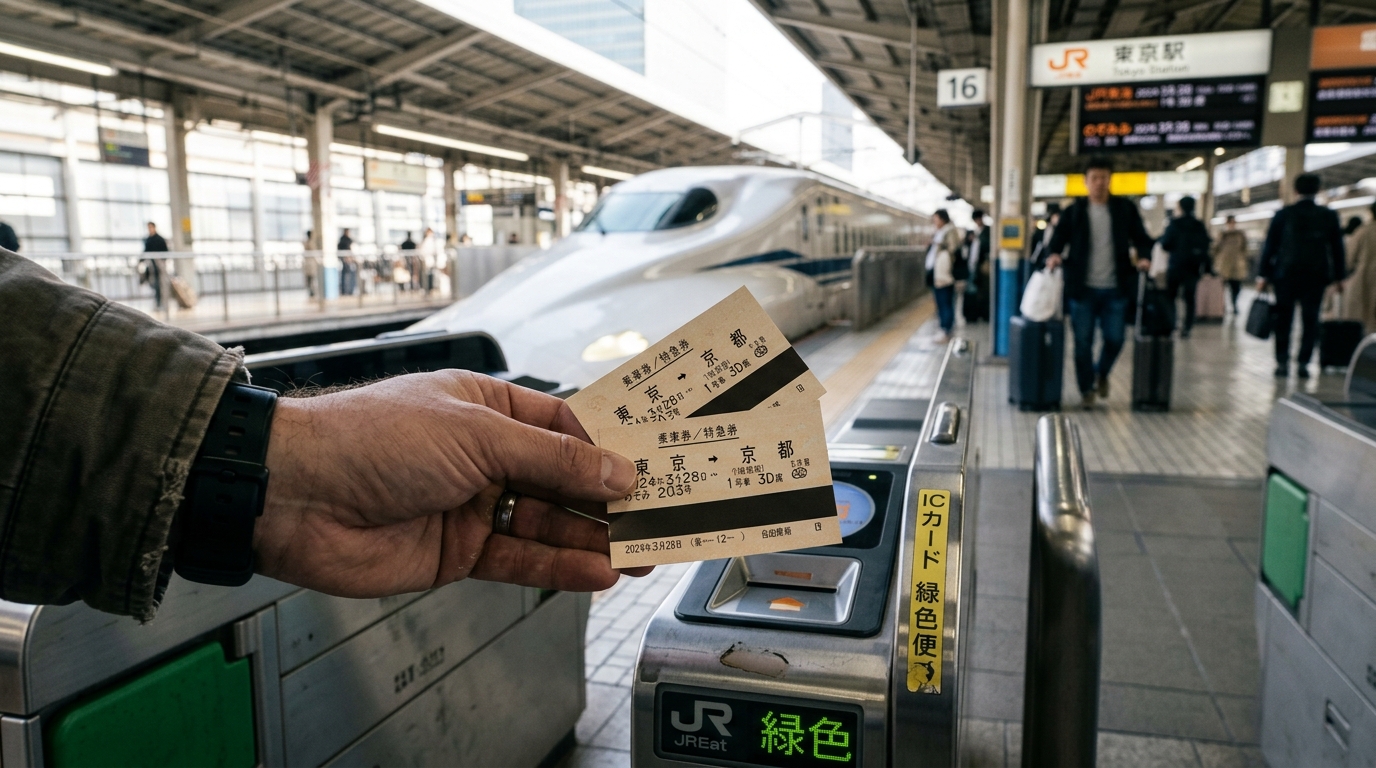
Tickets can also be affected by the route you choose. A journey using local trains before or after the Shinkansen may be issued as separate components. Read the ticket details carefully so you know the stations, service and seat covered.
Seat classes, reservations and luggage
Ordinary Car is the standard choice. Green Car offers a roomier layout on services where it is provided, and GranClass is available on selected northern trains. Facilities differ by train set, so power sockets, onboard sales and other amenities should be treated as service-specific rather than guaranteed.
Reservations are particularly useful for holidays, weekends, groups and travelers who need to sit together. On applicable Tokaido, Sanyo and Kyushu Shinkansen services, baggage with combined dimensions over 160 cm requires a seat linked to the oversized-baggage area. Other corridors can have different storage arrangements.
Using the map to plan a booking
- Identify the high-speed station, remembering that Osaka uses Shin-Osaka and Fukuoka uses Hakata.
- Find the line or connected corridors between the two stations.
- Check whether your preferred train stops at both stations.
- Compare live departures, seat classes and the complete fare for your date.
- Allow enough transfer time when changing operators, stations or line levels.
The diagram is intentionally simplified and not to scale. It supports route planning but does not replace the current timetable, station notices or service disruption information.
Northern and regional Shinkansen branches
North of Tokyo, most services share the Tohoku corridor before separating. Omiya is the junction for Joetsu and Hokuriku trains, Fukushima is the connection point for the Yamagata mini-shinkansen, and Morioka is the junction for the Akita route. The Hokkaido Shinkansen continues beyond Shin-Aomori through the Seikan Tunnel to Shin-Hakodate-Hokuto. Sapporo is not connected to the Shinkansen network in 2026, so travelers must use an onward conventional train or another mode of transport.
The Yamagata and Akita services are commonly called mini-shinkansen because the trains leave the dedicated high-speed corridor and continue on upgraded conventional lines. They still provide a through ride from Tokyo on relevant services, but journey times and onboard layouts differ from the main Tohoku corridor.
Map limitations and accessibility
A schematic map prioritizes connections over geography. Distances, curves and the physical position of cities are deliberately simplified, and minor stations are omitted. The text table above gives screen-reader users the same essential line and terminal information. For step-free travel, consult the current station accessibility page and contact the operator when assistance is required. Lift routes can involve a longer transfer than stairs or escalators, particularly at large interchange stations.
Service disruptions, maintenance, weather and seasonal timetable changes can alter the best route. Recheck the journey close to departure and leave a transfer margin instead of relying on the map alone.
Northern and regional Shinkansen branches
North of Tokyo, most services share the Tohoku corridor before separating. Omiya is the junction for Joetsu and Hokuriku trains, Fukushima is the connection point for the Yamagata mini-shinkansen, and Morioka is the junction for the Akita route. The Hokkaido Shinkansen continues beyond Shin-Aomori through the Seikan Tunnel to Shin-Hakodate-Hokuto. Sapporo is not connected to the Shinkansen network in 2026, so travelers must use an onward conventional train or another mode of transport.
The Yamagata and Akita services are commonly called mini-shinkansen because the trains leave the dedicated high-speed corridor and continue on upgraded conventional lines. They still provide a through ride from Tokyo on relevant services, but journey times and onboard layouts differ from the main Tohoku corridor.
Map limitations and accessibility
A schematic map prioritizes connections over geography. Distances, curves and the physical position of cities are deliberately simplified, and minor stations are omitted. The text table above gives screen-reader users the same essential line and terminal information. For step-free travel, consult the current station accessibility page and contact the operator when assistance is required. Lift routes can involve a longer transfer than stairs or escalators, particularly at large interchange stations.
Service disruptions, maintenance, weather and seasonal timetable changes can alter the best route. Recheck the journey close to departure and leave a transfer margin instead of relying on the map alone.
When comparing an airport with the Shinkansen, include city-center transfer and check-in time rather than comparing only the scheduled air time. For central Tokyo, Kyoto and Osaka journeys, rail often removes an airport transfer, while flights may remain practical for much longer trips. The best choice depends on the complete door-to-door itinerary.
Northern and regional Shinkansen branches
North of Tokyo, most services share the Tohoku corridor before separating. Omiya is the junction for Joetsu and Hokuriku trains, Fukushima is the connection point for the Yamagata mini-shinkansen, and Morioka is the junction for the Akita route. The Hokkaido Shinkansen continues beyond Shin-Aomori through the Seikan Tunnel to Shin-Hakodate-Hokuto. Sapporo is not connected to the Shinkansen network in 2026, so travelers must use an onward conventional train or another mode of transport.
The Yamagata and Akita services are commonly called mini-shinkansen because the trains leave the dedicated high-speed corridor and continue on upgraded conventional lines. They still provide a through ride from Tokyo on relevant services, but journey times and onboard layouts differ from the main Tohoku corridor.
Map limitations and accessibility
A schematic map prioritizes connections over geography. Distances, curves and the physical position of cities are deliberately simplified, and minor stations are omitted. The text table above gives screen-reader users the same essential line and terminal information. For step-free travel, consult the current station accessibility page and contact the operator when assistance is required. Lift routes can involve a longer transfer than stairs or escalators, particularly at large interchange stations.
Service disruptions, maintenance, weather and seasonal timetable changes can alter the best route. Recheck the journey close to departure and leave a transfer margin instead of relying on the map alone.
When comparing an airport with the Shinkansen, include city-center transfer and check-in time rather than comparing only the scheduled air time. For central Tokyo, Kyoto and Osaka journeys, rail often removes an airport transfer, while flights may remain practical for much longer trips. The best choice depends on the complete door-to-door itinerary.
Northern and regional Shinkansen branches
North of Tokyo, most services share the Tohoku corridor before separating. Omiya is the junction for Joetsu and Hokuriku trains, Fukushima is the connection point for the Yamagata mini-shinkansen, and Morioka is the junction for the Akita route. The Hokkaido Shinkansen continues beyond Shin-Aomori through the Seikan Tunnel to Shin-Hakodate-Hokuto. Sapporo is not connected to the Shinkansen network in 2026, so travelers must use an onward conventional train or another mode of transport.
The Yamagata and Akita services are commonly called mini-shinkansen because the trains leave the dedicated high-speed corridor and continue on upgraded conventional lines. They still provide a through ride from Tokyo on relevant services, but journey times and onboard layouts differ from the main Tohoku corridor.
Map limitations and accessibility
A schematic map prioritizes connections over geography. Distances, curves and the physical position of cities are deliberately simplified, and minor stations are omitted. The text table above gives screen-reader users the same essential line and terminal information. For step-free travel, consult the current station accessibility page and contact the operator when assistance is required. Lift routes can involve a longer transfer than stairs or escalators, particularly at large interchange stations.
Service disruptions, maintenance, weather and seasonal timetable changes can alter the best route. Recheck the journey close to departure and leave a transfer margin instead of relying on the map alone.
When comparing an airport with the Shinkansen, include city-center transfer and check-in time rather than comparing only the scheduled air time. For central Tokyo, Kyoto and Osaka journeys, rail often removes an airport transfer, while flights may remain practical for much longer trips. The best choice depends on the complete door-to-door itinerary.
Frequently asked questions
What are the main Shinkansen lines in Japan?
The principal corridors include Tokaido, Sanyo, Kyushu, Tohoku, Hokkaido, Joetsu and Hokuriku, plus the Yamagata and Akita mini-shinkansen routes.
Does every Shinkansen start at Tokyo Station?
No. Tokyo is the main eastern hub, but many services start elsewhere. Shin-Osaka, Hakata, Kagoshima-Chuo, Kanazawa, Tsuruga and other stations are important terminals.
Is Osaka Station on the Shinkansen map?
The Shinkansen serves Shin-Osaka, not Osaka Station. Transfer between the two for central Osaka and Umeda.
How do I read through-services on the map?
A train may continue across line boundaries, such as Tokaido to Sanyo. Confirm the train name, destination and stops for your date.
Are map fares fixed?
No. A Shinkansen total combines the base fare and the Shinkansen limited-express charge, with seat, train and seasonal factors affecting the amount.
![How to Pick Up Shinkansen Tickets: Skip 45-Min Lines [2026]](https://static.trainbook.online/images/articles/cover-1774027511628.png)
![Shinkansen Family Tickets & Group Booking: How to Sit Together [2026]](https://static.trainbook.online/images/articles/cover-1774028141349.png)