Buy Shinkansen Tickets Online: Booking, Seats & Prices (2026)
Buying Shinkansen tickets online lets you compare trains before you reach a Japanese station. A good booking page should show the route, departure time, train name, seat option, luggage conditions and full amount before payment. This guide explains what to check so you can book confidently without relying on a fixed timetable or an outdated example price.
What a Shinkansen ticket includes
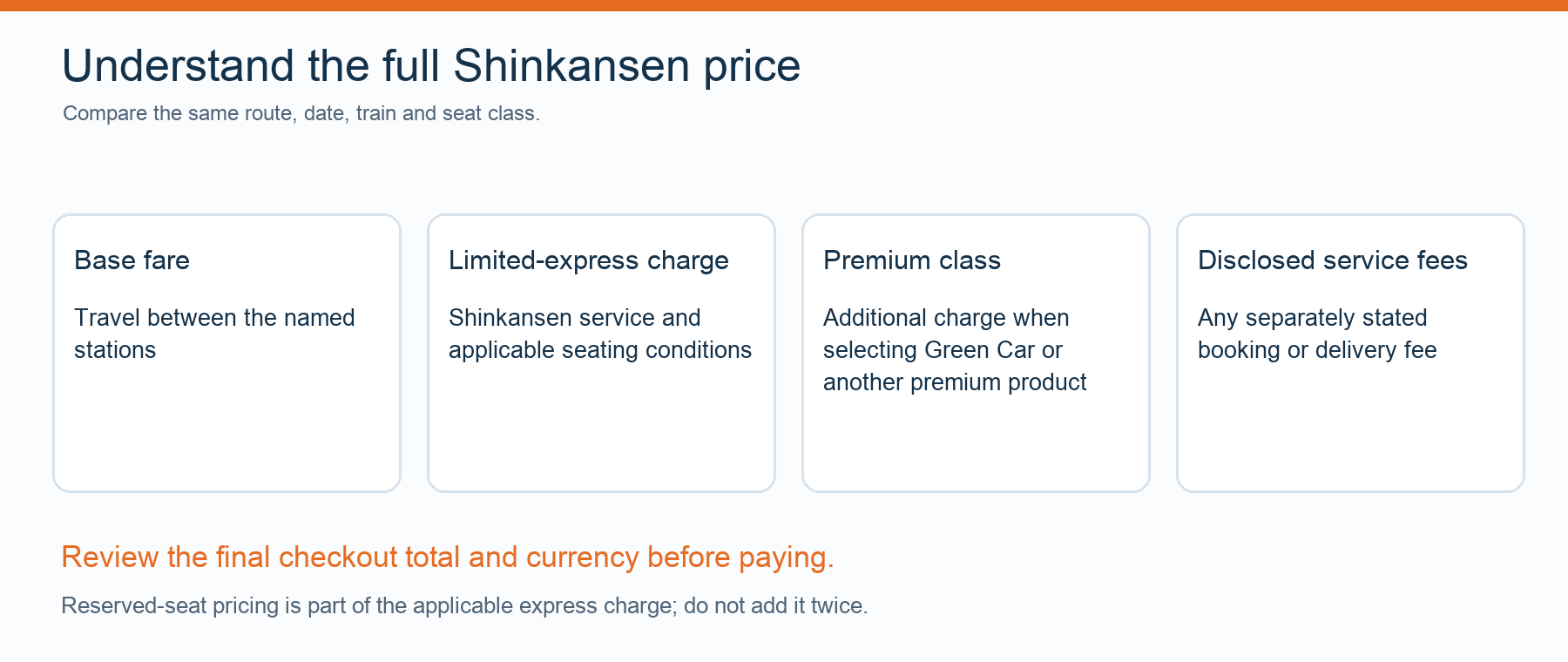
A complete Shinkansen fare normally contains two railway components: the basic fare for traveling between the origin and destination, and the Shinkansen limited-express charge for using the high-speed service. Depending on the train and seat, the total may also reflect a reserved-seat component or a Green Car premium. A booking service may display a separate service fee; review the full total before paying.
The price is not one universal number. Route distance, train category, seat class, travel date and seasonal rules can change the amount. Use examples only for planning and search the exact journey for a current quote.
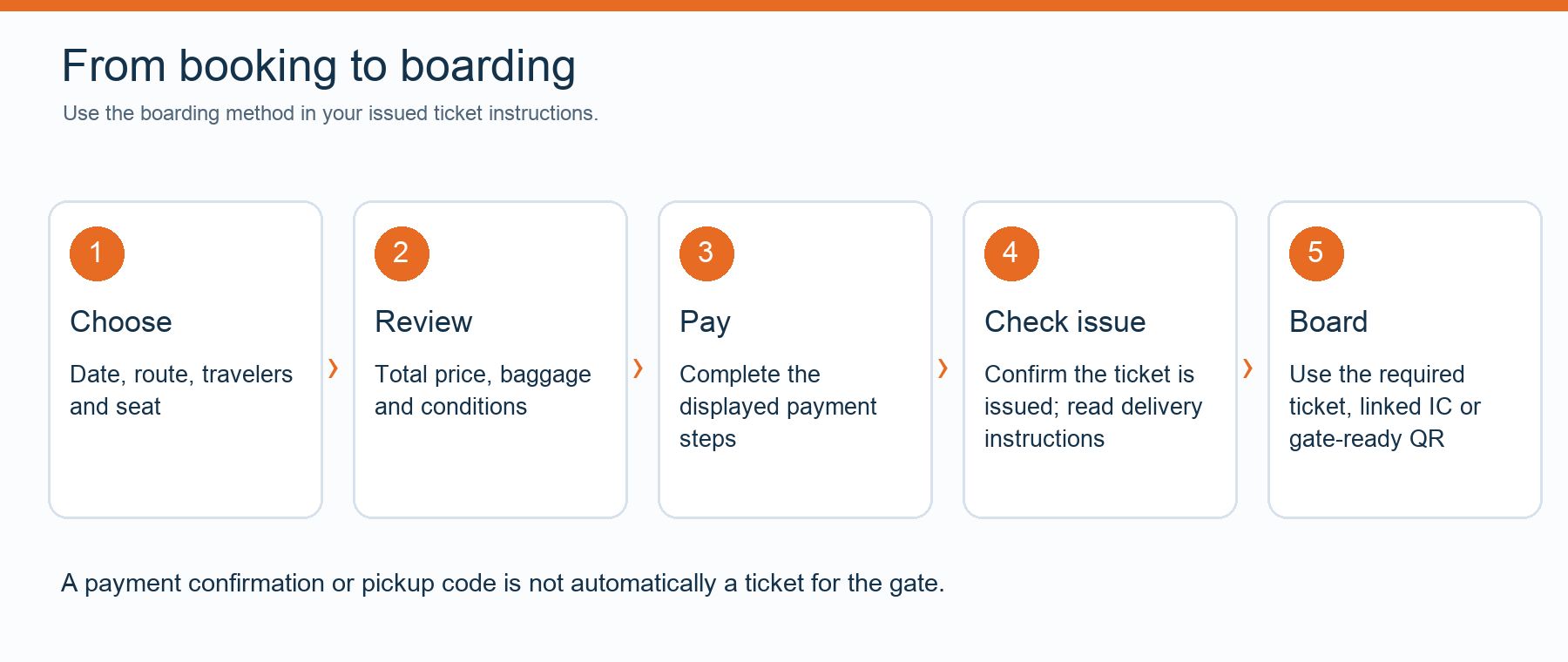
How to buy Shinkansen tickets online
- Choose the correct stations. Tokyo and Shinagawa both serve the Tokaido Shinkansen, while Osaka-bound Shinkansen services use Shin-Osaka rather than Osaka Station.
- Select the travel date and passenger count. Check that children are entered in the correct age category.
- Compare actual trains. Review departure and arrival times, train name, transfers and seat availability.
- Choose a seat. Select ordinary or Green Car and, when offered, reserved or non-reserved travel.
- Declare relevant luggage. On Tokaido, Sanyo, Kyushu and Nishi Kyushu services, ordinary suitcases over 160 cm and up to 250 cm in total dimensions require a seat with an oversized baggage area.
- Review delivery and collection instructions. The usable ticket format depends on the route and booking product; do not assume every booking is delivered as the same QR code.
- Check the final total and pay. Card acceptance depends on the payment method, issuer and authentication checks shown at checkout.
Nozomi, Hikari and Kodama
On the Tokaido Shinkansen, Nozomi makes the fewest stops and is usually the fastest choice between Tokyo, Kyoto and Shin-Osaka. Hikari stops more often and can be useful for travelers comparing schedules or eligible rail-pass conditions. Kodama stops at every Shinkansen station along its operating section and takes longer, but it may suit a short segment or a specific departure time.
Do not choose by name alone. The best train is the one that matches your stations, date, arrival target and seat needs. Search results provide the current timetable and availability.
Reserved seats, non-reserved seats and Green Car
A reserved seat gives you an assigned car and seat on a particular train. It is useful during holidays, weekends, evening peaks, group trips and journeys with large luggage. A non-reserved ticket, when available for the selected service, does not assign a seat and the relevant cars can fill. Any departure flexibility remains subject to that ticket’s conditions.
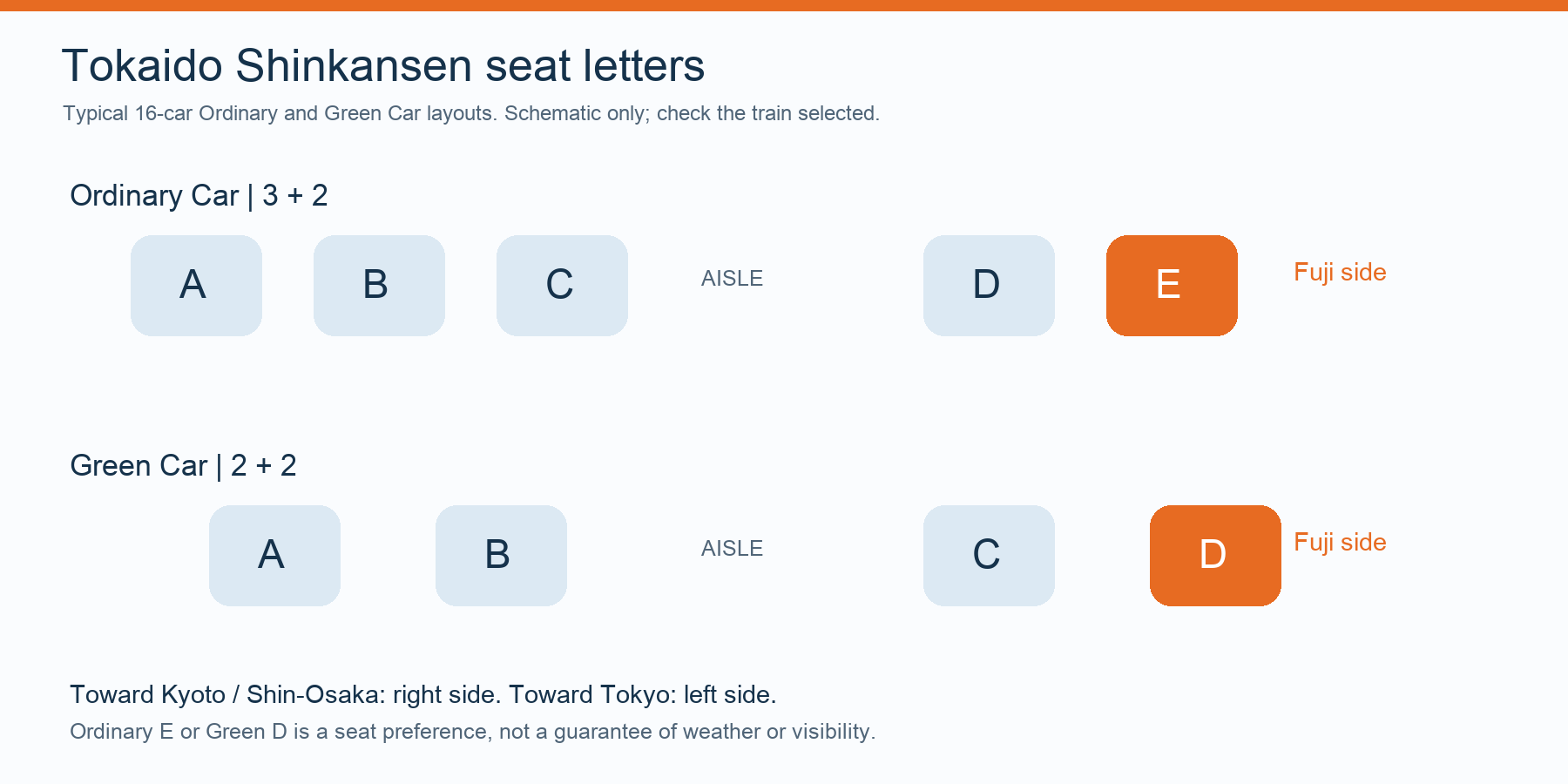
Green Car is a premium cabin, generally offering more personal space. Ordinary reserved seats are comfortable for most travelers. Seat maps and exact amenities vary by train set, so treat window views, power outlets and onboard sales as service-specific rather than guaranteed.
Oversized baggage rules
On Tokaido, Sanyo, Kyushu and Nishi Kyushu Shinkansen trains, ordinary suitcases whose three dimensions total more than 160 cm and up to 250 cm require a seat with an oversized baggage area. Exactly 160 cm does not exceed that threshold; ordinary luggage over 250 cm is not allowed. The general allowance is two items per person, each up to 30 kg and 2 m long, excluding small personal belongings. Measure wheels and handles. The reservation-free deck-storage trial on some Tokaido/Sanyo trains does not remove the oversized-suitcase requirement.
Smaller suitcases normally use overhead racks or space around your seat, subject to safety and availability. Travelers with multiple large bags should consider luggage forwarding because station transfers, stairs and crowded local trains can be difficult.
Tokyo, Kyoto and Osaka station choices
For Tokyo departures, compare Tokyo Station and Shinagawa Station. Tokyo Station offers the widest connections and many terminating or originating services, while Shinagawa can be more convenient for southern Tokyo and Haneda Airport connections. Kyoto has one main Shinkansen station. In Osaka, the bullet train arrives at Shin-Osaka; transfer to JR local services or the Osaka Metro for Umeda, Namba and other city districts.
Allow extra time for unfamiliar stations, elevators and ticket collection. Follow the live signs for your train and platform instead of relying on a platform number copied from an old guide.
When to book
Book earlier for busy dates, particularly if you need adjacent seats or oversized-baggage space. Nozomi operates with all seats reserved during specified peak periods, including Silver Week and designated three-day weekends in 2026 as well as Golden Week, Obon and New Year. At quieter times, more choices may remain closer to departure, but availability is never guaranteed.
General JR reserved-seat sales open at 10:00 JST one calendar month before travel, not a fixed 30 days. SmartEX offers limited products and seats up to one year ahead, with final train and seat details confirmed around one month before travel; oversized-baggage seats are excluded from that one-year window. A seller may accept an earlier request, but that is not the same as a confirmed, issued ticket. Sales windows and change rules depend on the railway and booking product. Check the conditions displayed for your ticket, including cancellation deadlines, train restrictions and whether changes require support.
Individual tickets or a Japan Rail Pass
The nationwide JAPAN RAIL PASS requires a separately purchased NOZOMI MIZUHO Ticket, together with a valid pass, for Nozomi or Mizuho travel. Regional passes have different coverage. A rail pass is not automatically cheaper. Build the actual itinerary, identify which trains and routes are eligible, and compare the pass price with individual tickets. A traveler making only Tokyo–Kyoto–Osaka journeys may reach a different answer from someone taking several eligible long-distance trips across Japan.
Ticket collection, changes and travel-day checks
Online booking does not remove the need to read the delivery instructions. Some products are collected from a machine or counter, some are linked to a compatible IC card, and others use a digital travel credential. Confirm which stations support the stated method and bring only the credentials specified for that product. A gate-ready QR-Ticket is different from a pickup QR code. If you have paid but have not received an issued ticket or collection instructions, check the order status and contact the seller rather than assuming the payment email can open the gate.
Before travel, recheck the departure station, train name and time. Tokyo and Shinagawa are different stations, and Osaka Station is not the Shinkansen stop. If a disruption occurs, follow the railway's live information and the conditions attached to the ticket. Change and refund rights vary by product and timing.
Common booking mistakes
Do not choose the wrong direction, assume every train stops at every station, or enter passenger details incorrectly. Review AM and PM times carefully, allow for the local transfer after the Shinkansen, and avoid scheduling a flight or fixed event immediately after the planned arrival.
Final review before payment
Read the itinerary from top to bottom: passenger count, stations, date, train, seat, luggage option, delivery method, currency and total. Save the confirmation and support contact details. This final check prevents more problems than relying on a headline price or a remembered departure time.
Plan and book your trip
- Japan Shinkansen map and line guide
- How Shinkansen fares work
- Tokyo to Kyoto Shinkansen
- Tokyo to Osaka Shinkansen
Search your travel date to compare current trains, seats and total prices.
Official references
Check JR ticket components, SmartEX reservation windows, SmartEX luggage-seat reservations, JR luggage limits, Nozomi peak dates and JAPAN RAIL PASS special tickets. SmartEX instructions apply to SmartEX products; use your seller’s instructions for your booking.