
Japanese Train Guide: Shinkansen, Local Trains & Subways
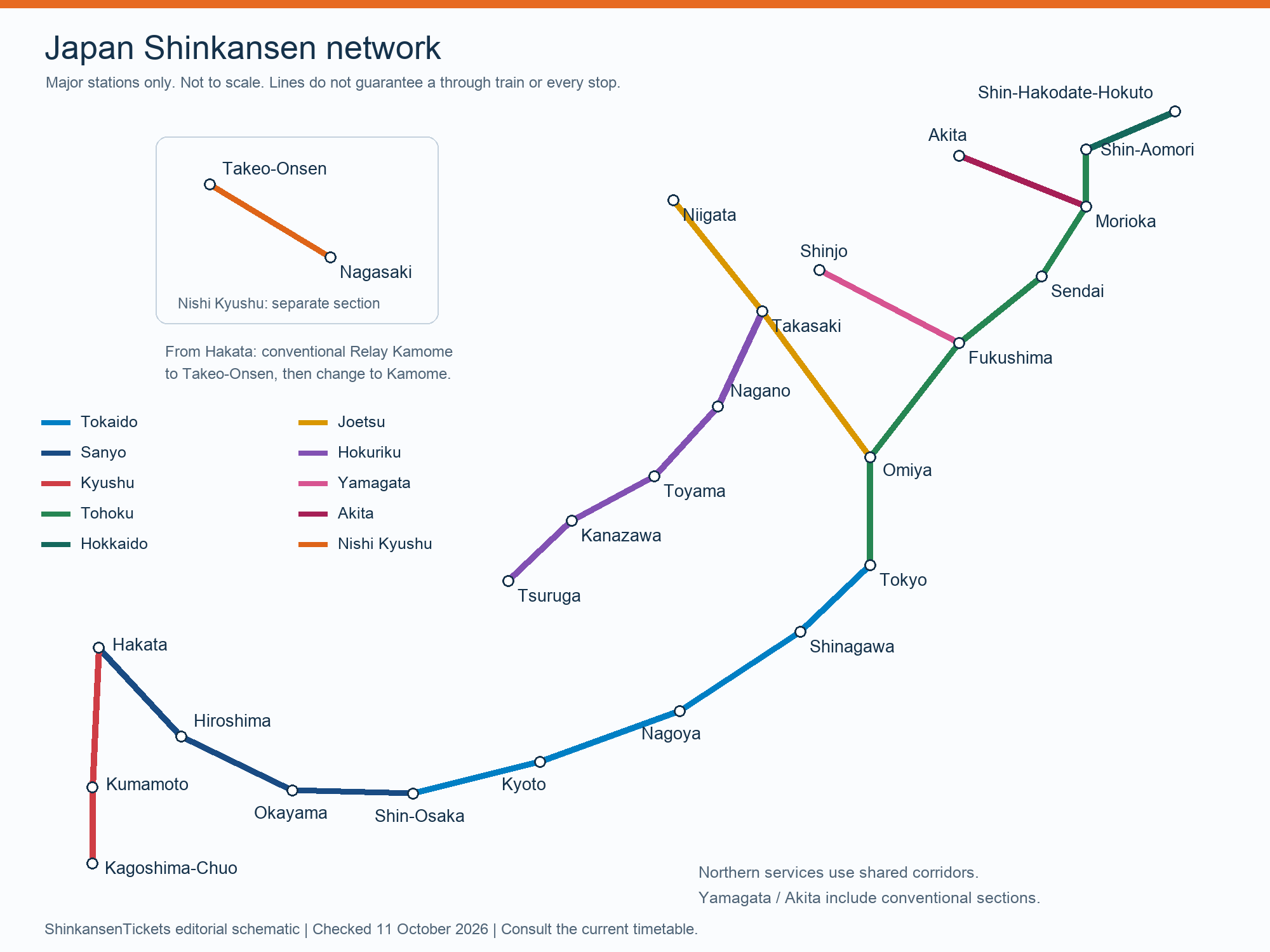
Japan’s rail network includes Shinkansen, limited express, local and rapid trains, subways and private railways. Choose the service by distance, route, seat needs and the complete fare.
Main Types of Trains in Japan
Shinkansen Bullet Trains
The Shinkansen connects major cities on dedicated high-speed lines. It is usually the simplest choice for journeys such as Tokyo to Kyoto, Tokyo to Shin-Osaka, or Shin-Osaka to Hiroshima. Train names, stopping patterns and seat rules vary by line, so check both the service name and destination before boarding.
Use the Japan Shinkansen map and route guide to compare major lines and stations. When you are ready to travel, search available Shinkansen routes and ticket options.
Limited Express Trains
Limited express trains link airports, regional cities and destinations not directly served by the Shinkansen. They stop at fewer stations than local or rapid trains and may require both a base fare and a limited express supplement. Some services are all-reserved, while others include unreserved cars.
Local, Rapid and Commuter Trains
Local trains stop at every station. Rapid, special rapid and similar services skip selected stops but often use the same tracks and platforms. Always check the departure display because a faster train may not stop at your destination.
Urban commuter cars usually use long bench seats to create standing space. Seats are generally first-come, first-served, except for clearly marked priority areas.
Subways and Private Railways
Tokyo, Osaka, Kyoto and other cities combine municipal subway lines with JR and private railway networks. Transfers between operators may require walking through a different gate or paying a separate fare. Station numbers, line colors and operator logos help distinguish routes with similar names.
Understanding Japanese Train Tickets
Base Fare and Express Supplements
A local journey usually needs only the base fare. A Shinkansen or limited express journey normally includes the base fare plus an express supplement. These may appear on one combined ticket or on separate tickets. If you receive two paper tickets for the same journey, insert both together when instructed at the gate and collect them from the other side.
IC Cards for Local Travel
Rechargeable IC cards are convenient on many local trains, subways and buses. Touch in at the origin and touch out at the destination. Coverage is broad but not universal, and an IC card alone is not a substitute for every Shinkansen or reserved limited express ticket.
Online Booking, QR Codes and Ticket Pickup
Online bookings may provide a gate-ready QR code, a physical ticket, or instructions to collect tickets before travel. Follow the fulfillment method shown in your booking confirmation. See the online Shinkansen ticket booking guide and the ticket pickup guide before arriving at the station.
Shinkansen Seat Types
Seat availability depends on the line and train. Ordinary and Green Car are cabin classes; reserved and non-reserved describe seat assignment. Ordinary seating is often 3+2 on the Tokaido line, while other train sets can use different layouts. An issued reservation assigns a particular train, car and seat; group preferences are subject to availability.
| Seat type | What to expect | Best for |
|---|---|---|
| Non-reserved | First-come, first-served seating in designated cars when offered | Flexible travel outside busy periods |
| Ordinary reserved | An assigned train, car and seat shown on the issued ticket | Most visitors, groups and peak travel |
| Green Car | A premium cabin with more personal space; facilities vary by train | Long trips and travelers prioritizing comfort |
| GranClass | Premium seating on selected trains; onboard services vary | Premium travel on applicable northern and eastern services |
GranClass is offered on applicable Tohoku, Hokkaido, Hokuriku and Joetsu trains, not on Tokyo–Kyoto services. Refreshments and attendant service vary; some GranClass trains provide seating only. Supreme Class, a different private-cabin product, began on selected Tokaido/Sanyo services on 1 October 2026. A railway service is available through this site only when it is shown in the actual booking options.
For a more detailed comparison, read the Shinkansen seat classes guide.
Finding your train
Confirm the operator, line, train name, stopping pattern and platform on the departure display. Follow the issued boarding method, locate your car marker and let passengers leave before boarding. Read the boarding guide for the full process.
Luggage, Accessibility and Train Etiquette
Luggage
Keep smaller bags on the overhead rack or in front of you without blocking aisles. On Tokaido, Sanyo, Kyushu and Nishi Kyushu Shinkansen services, ordinary suitcases with total dimensions over 160 cm and up to 250 cm require a seat with an oversized baggage area. Bags of exactly 160 cm do not exceed the threshold. Ordinary luggage over 250 cm cannot be brought aboard. The general limit is two items per passenger, each up to 30 kg and 2 m long, excluding small personal belongings. The reservation-free deck-storage trial on some Tokaido/Sanyo trains does not remove the oversized-suitcase reservation rule.
Accessibility
Major stations commonly provide elevators, accessible toilets and staff assistance, but transfer routes can be long. Travelers who need boarding assistance should allow extra time and contact the relevant operator in advance when possible.
Etiquette
Queue behind platform markings, let passengers leave first, keep audio quiet and leave doors, aisles and luggage areas clear. Use designated bins or take rubbish with you.
Planning Your Japanese Train Journey
Nozomi operates with all seats reserved during specified peak periods, including additional holiday weekends in 2026. A nationwide JAPAN RAIL PASS alone does not cover Nozomi or Mizuho; the appropriate separately purchased NOZOMI MIZUHO Ticket is also required. Regional passes have different conditions.
Official references: JR Central luggage rules, Nozomi peak dates, JAPAN RAIL PASS special tickets, GranClass and Supreme Class.
Ready to plan your trip? Search Shinkansen routes and ticket options for your travel date.