Tokaido Shinkansen Guide: Trains, Stations, Seats & Tickets
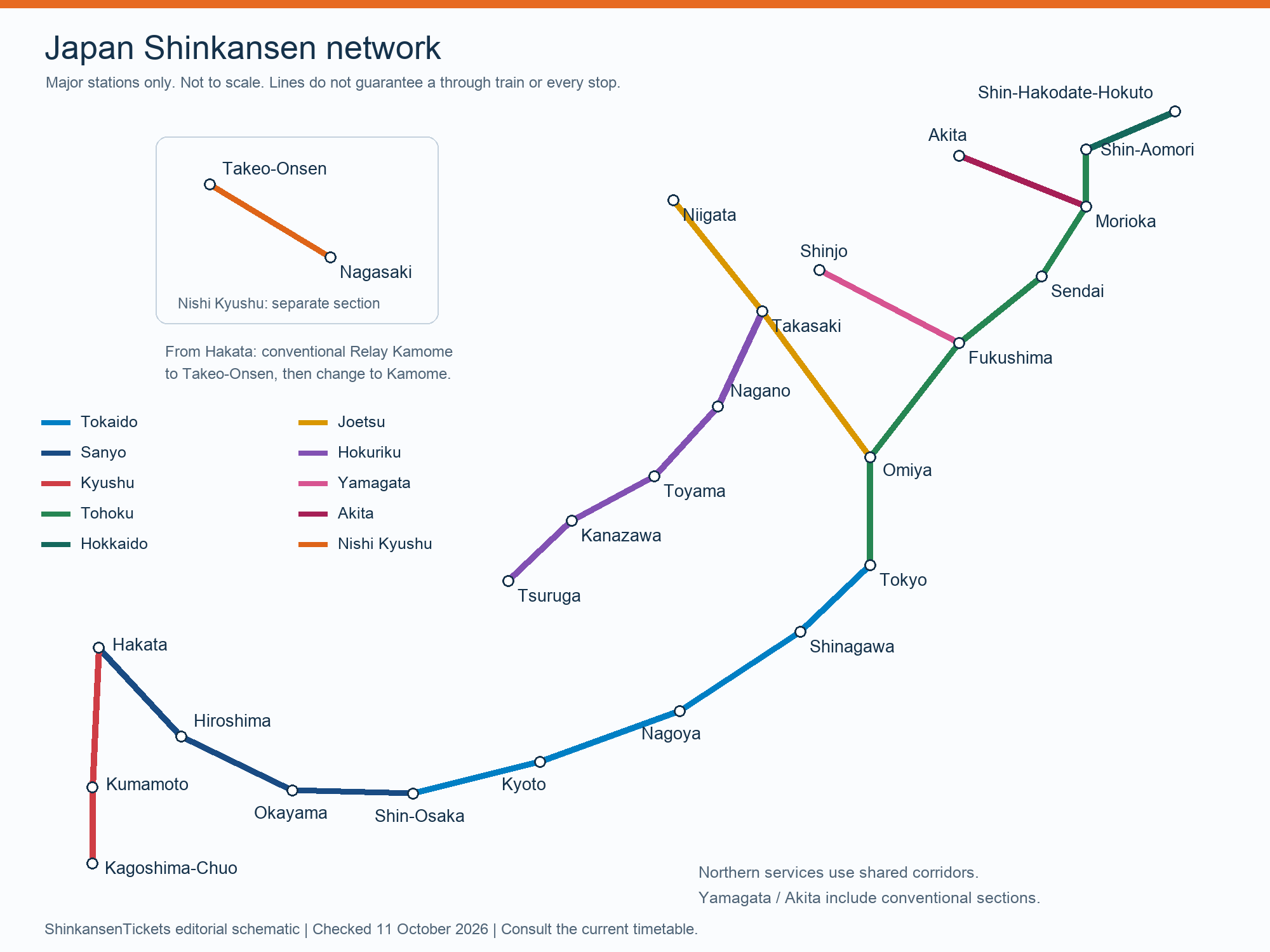
The Tokaido Shinkansen connects Tokyo with Shin-Osaka via Nagoya and Kyoto. Nozomi is normally the fastest service, Hikari makes more stops, and Kodama serves every station along its operating section. Your actual journey time and fare depend on the departure, date and ticket product; no single price or duration applies to every train.
Where the Tokaido line goes
The line has 17 stations: Tokyo, Shinagawa, Shin-Yokohama, Odawara, Atami, Mishima, Shin-Fuji, Shizuoka, Kakegawa, Hamamatsu, Toyohashi, Mikawa-Anjo, Nagoya, Gifu-Hashima, Maibara, Kyoto and Shin-Osaka. At Shin-Osaka it connects with the Sanyo Shinkansen toward Hiroshima and Hakata. A through Nozomi may continue onto Sanyo without a train change.
Use Shin-Osaka for a Shinkansen trip to Osaka. Osaka Station, Umeda and Namba require local connections. Tokyo and Shinagawa are separate departure stations: choose the one you intend to use and confirm the issued ticket names it. The network map explains the main line boundaries.
Nozomi, Hikari or Kodama?
| Service | Stopping pattern | How to compare it |
|---|---|---|
| Nozomi | Major cities: Tokyo, Shinagawa, Shin-Yokohama, Nagoya, Kyoto and Shin-Osaka | Usually the fastest option between major Tokaido stations |
| Hikari | Major cities plus selected intermediate stations; stops vary | Useful for intermediate stops or an eligible nationwide JR Pass itinerary |
| Kodama | All stations along its operating section | Useful for smaller stations and slower-paced journeys |
As planning guidance, a Nozomi from Tokyo to Shin-Osaka commonly takes around 2 hours 20–40 minutes. A Hikari can take around three hours, while many through Kodama services take close to four hours; individual departures vary. For Kyoto, the Nozomi trip is a little over two hours. Check the official current timetable for the exact train, including whether an additional service operates on your date.
The Tokaido line's maximum operating speed is 285 km/h; speed alone does not determine journey time. Do not assume that one train's advertised fastest timing includes your local transfer or station navigation.
How ticket prices and rail passes work
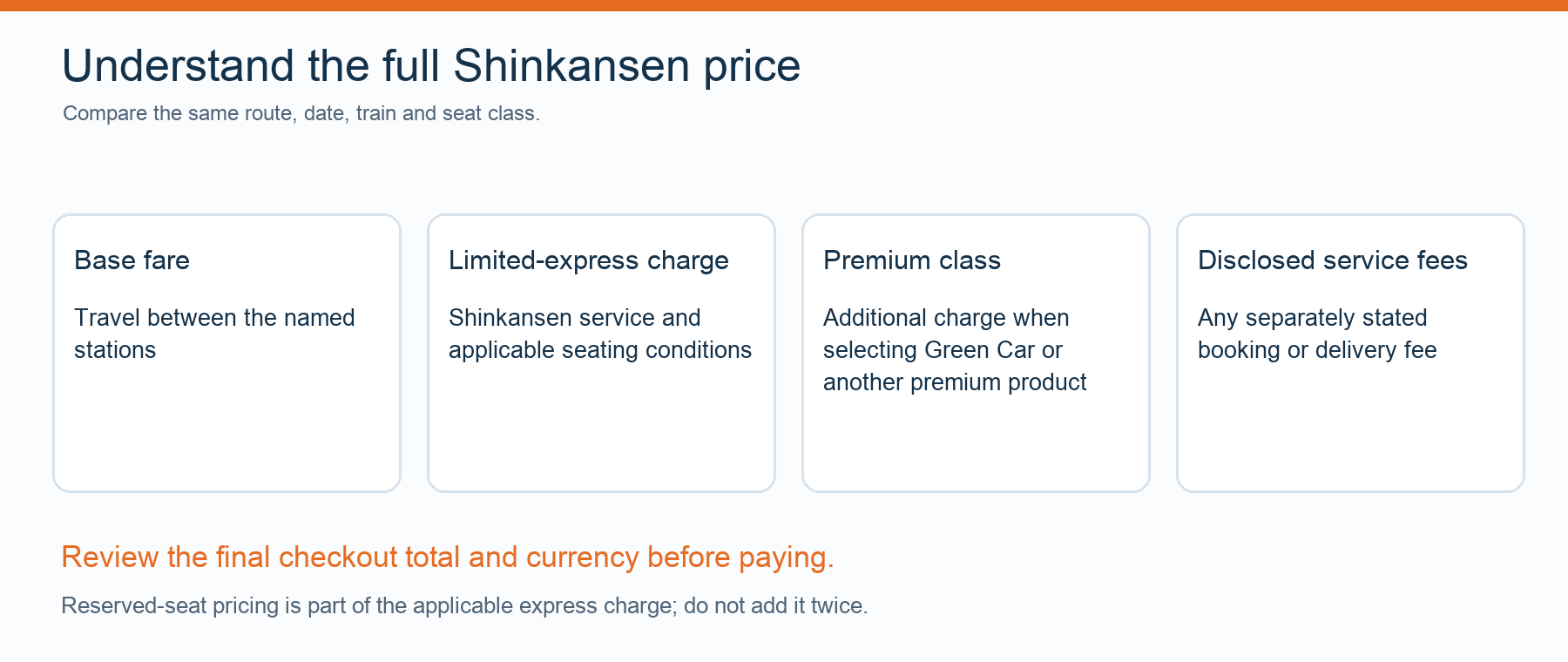
The complete railway price includes a basic fare and the relevant Shinkansen limited-express charge. The train, reservation type, seat class and railway calendar can affect the total. Compare any separate seller fee and payment currency before paying. Fixed yen prices or old exchange-rate conversions in an article are not a current offer.
The nationwide JAPAN RAIL PASS covers eligible Hikari and Kodama travel, but using Nozomi requires the separately purchased NOZOMI MIZUHO Ticket together with a valid pass. Buy the required ticket before boarding. Regional passes have different boundaries, and a JR West pass should not be assumed to cover the Tokaido line. Consult the official nationwide pass rules and the fare breakdown.
Seat classes and busy dates
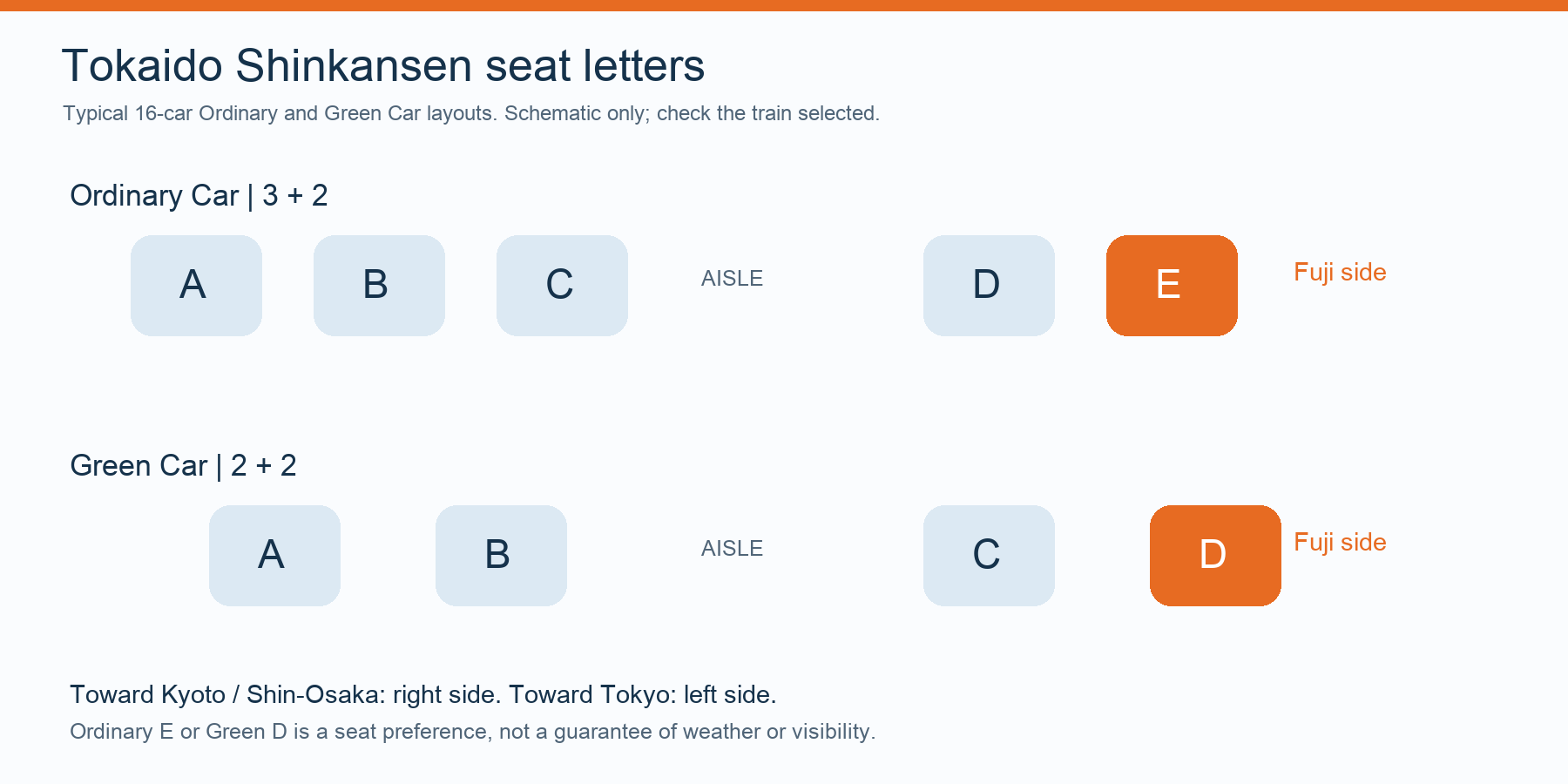
Ordinary Car on the usual 16-car Tokaido trains has a 3+2 arrangement; Green Car generally has 2+2 seats and more personal space. Facilities depend on the train series. GranClass is not offered on this line. A separate Supreme Class private-cabin service began on selected Tokaido/Sanyo trains on 1 October 2026; consult the official service guide, and book only a product actually offered for your departure.
Reserved and non-reserved refer to seat assignment. An issued reservation gives you a specified train, car and seat. Nozomi normally has non-reserved seats in cars 1 and 2, but all seats become reserved during announced peak periods. The 2026 calendar includes Silver Week and designated three-day weekends as well as Golden Week, Obon and New Year. Check the official peak-period calendar before relying on a non-reserved option.
Choosing the Mount Fuji side
On the standard Tokaido layout, Ordinary Car seat E and Green Car seat D face the usual Mount Fuji viewing side in both directions: right toward Kyoto/Shin-Osaka, left toward Tokyo. Window seats are subject to availability, and clouds can hide the mountain. There is no guaranteed view or universal minute after departure. Watch the train's progress toward the Mishima–Shin-Fuji area and read the Mount Fuji seat guide.
Luggage and onboard facilities
Ordinary suitcases measuring over 160 cm and up to 250 cm in total length, width and height require a seat with an oversized baggage area. Exactly 160 cm does not cross that threshold. Ordinary luggage over 250 cm cannot be taken aboard; the general allowance is two items per passenger, each no more than 30 kg and 2 m long, excluding small personal items.
The area behind the relevant seats is shared by passengers who reserved it. The trial of reservation-free deck storage on some trains does not remove the reservation requirement for an oversized suitcase. Check JR Central's luggage rules before booking.
Wi-Fi and power facilities vary by train and connection conditions; keep essential ticket information available offline. Buy food and drinks before boarding if you need them, rather than relying on a particular onboard service.
Station food, gates and arrival
Tokyo Station has shops selling ekiben and other food, but allow time for queues and the walk to your platform. Use the departure board to match your train number, time, platform and car. Do not rely on an old platform number or a fixed transfer-time estimate.
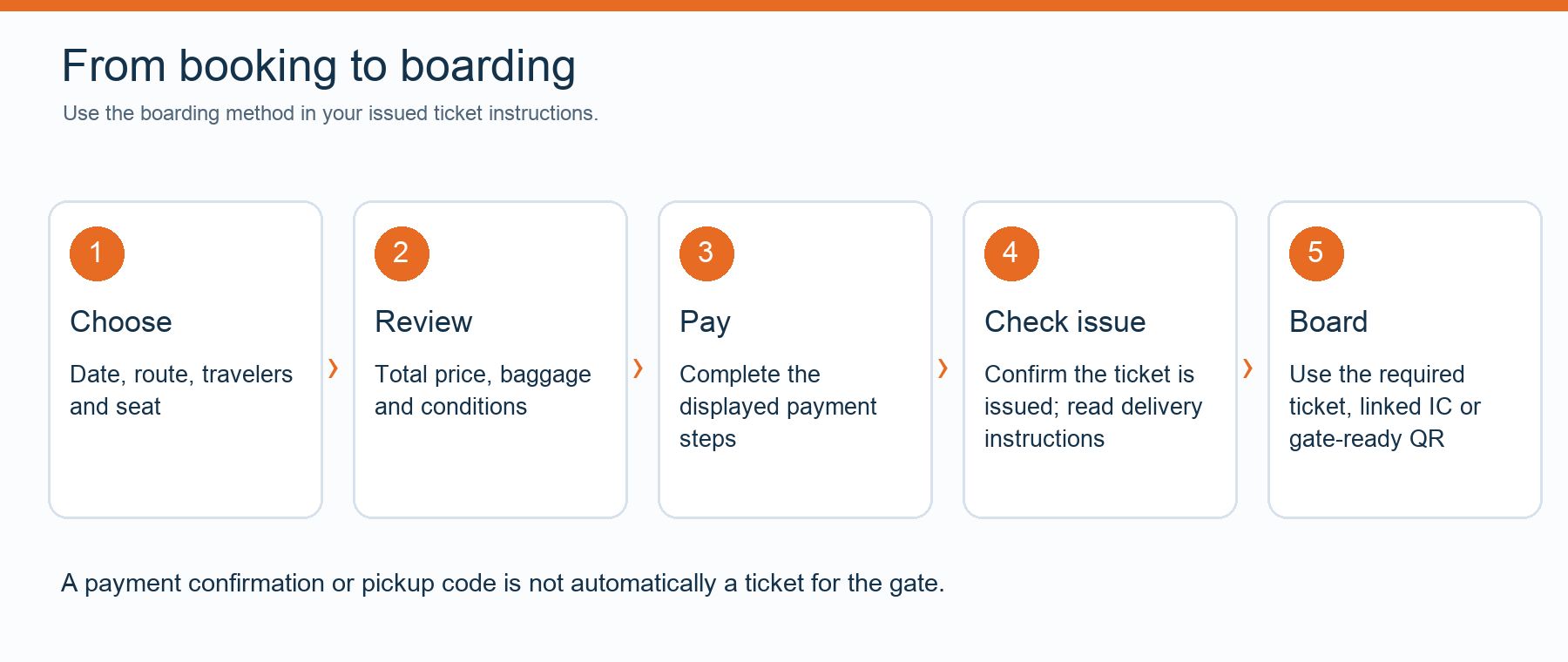
A boarding QR ticket is different from a pickup voucher. Some bookings require paper-ticket collection or a linked IC card. Follow the issued instructions and read how to board. At Shin-Osaka, compare JR services to Osaka Station or the Osaka Metro Midosuji Line for other city districts, allowing for any separate local fare.
Compare Tokyo–Kyoto journeys or Tokyo–Shin-Osaka journeys for your date.