
Japan Shinkansen Map 2026: Lines, Routes & Connections
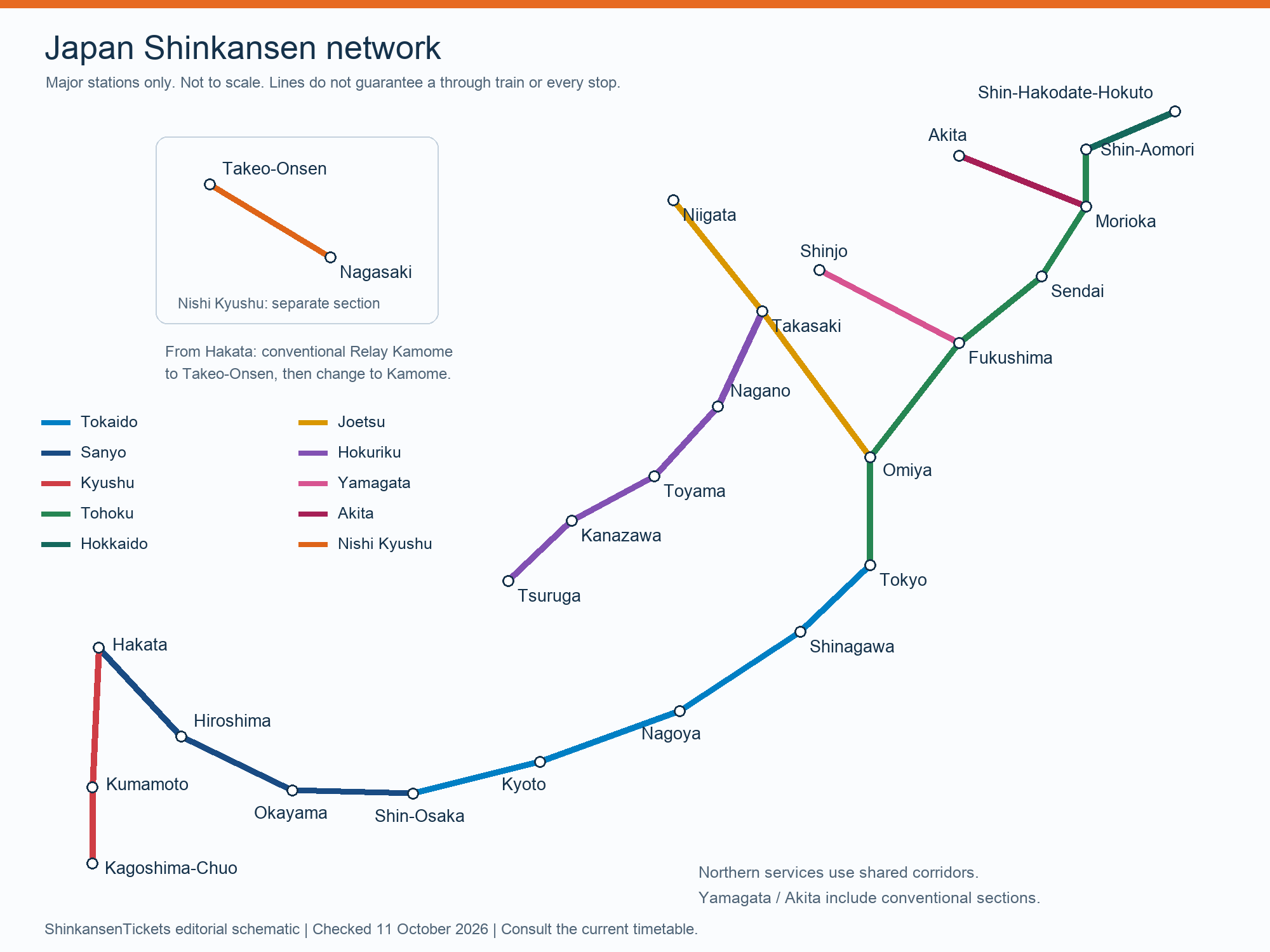
The Japan Shinkansen map is a network of connected corridors. The Tokaido Shinkansen links Tokyo, Nagoya, Kyoto and Shin-Osaka; the Sanyo line continues from Shin-Osaka to Hakata. Some trains cross line boundaries, while other journeys require a transfer. Use this diagram with the line table, then check the actual stops and departure time for your travel date.
Japan Shinkansen lines and main routes
| Line or service corridor | Main route | Useful stations |
|---|---|---|
| Tokaido | Tokyo–Shin-Osaka | Shinagawa, Nagoya, Kyoto |
| Sanyo | Shin-Osaka–Hakata | Okayama, Hiroshima, Kokura |
| Kyushu | Hakata–Kagoshima-Chuo | Shin-Tosu, Kumamoto |
| Nishi Kyushu | Takeo-Onsen–Nagasaki | Ureshino-Onsen, Shin-Omura, Isahaya |
| Tohoku | Tokyo–Shin-Aomori | Omiya, Sendai, Morioka |
| Hokkaido | Shin-Aomori–Shin-Hakodate-Hokuto | Kikonai, Shin-Hakodate-Hokuto |
| Joetsu | Omiya–Niigata, with services from Tokyo | Takasaki, Echigo-Yuzawa |
| Hokuriku | Takasaki–Tsuruga, with services from Tokyo | Nagano, Toyama, Kanazawa, Fukui |
| Yamagata mini-shinkansen | Fukushima–Shinjo, with through services from Tokyo | Yamagata, Shinjo |
| Akita mini-shinkansen | Morioka–Akita, with through services from Tokyo | Kakunodate, Akita |
Where to change trains
Tokyo connects the southwestern Tokaido corridor with northern and inland routes. The platforms and gate areas differ, so allow time to find the correct line. Shinagawa is another Tokaido departure point, useful for some journeys from southern Tokyo or Haneda Airport. Shinjuku and Shibuya require a local connection to a Shinkansen station.
Shin-Osaka is the Tokaido–Sanyo boundary and the high-speed station for Osaka. It is separate from Osaka Station, Umeda and Namba. Hakata is Fukuoka's principal Shinkansen station and the Sanyo–Kyushu boundary.
Nishi Kyushu is a separate corridor. For a typical Hakata–Nagasaki journey, take a Relay Kamome limited express and change to the Kamome Shinkansen at Takeo-Onsen. Do not read the map as a continuous Shinkansen ride from Hakata to Nagasaki. See JR Kyushu's Kamome transfer guidance.
Why train names matter
On the Tokaido line, Nozomi makes the fewest stops, Hikari makes more, and Kodama serves every station along its operating section. Sanyo and Kyushu services also include Mizuho, Sakura and Tsubame. Northern names include Hayabusa, Yamabiko, Toki and Kagayaki. A station on a colored line is not necessarily a stop for every train.
Tokyo–Kyoto and Tokyo–Shin-Osaka use the Tokaido line. Shin-Osaka–Hiroshima uses Sanyo; Hakata–Kumamoto uses Kyushu. Tokyo–Niigata services leave the Tohoku corridor at Omiya, while Hokuriku services continue via Takasaki toward Nagano and Tsuruga. A through-service can cross several line names without requiring passengers to change trains.
Northern routes and map limits
Yamagata and Akita trains leave the main Tohoku corridor at Fukushima and Morioka respectively, continuing over upgraded conventional lines. Their train layouts and speeds differ from full-size high-speed trains. The Hokkaido Shinkansen reaches Shin-Hakodate-Hokuto; Sapporo is not a Shinkansen destination in 2026.
This is a route-planning overview, not a geographical map or a live service display. Minor stops are omitted. The text table provides the essential connections for readers who cannot use the image. Check current schedules and disruption notices; lift routes and changes between operators can take longer than a simple station diagram suggests.
Tickets, passes and reservations
A route map helps identify the railway corridor. Search your exact boarding station, destination and travel date to check departures and available seats, then review the reservation and boarding instructions for your selected journey.
A valid nationwide JAPAN RAIL PASS must be accompanied by the eligible NOZOMI MIZUHO Ticket when using Nozomi or Mizuho. Regional passes have their own coverage. Check the official pass conditions for the exact train and journey.
Nozomi on the Tokaido and Sanyo lines operates with all seats reserved during specified peak periods. The 2026 schedule includes Silver Week and designated three-day weekends as well as Golden Week, Obon and New Year. Check the current official dates; a network map cannot show these temporary seating rules.
Luggage and your seat choice
On Tokaido, Sanyo, Kyushu and Nishi Kyushu Shinkansen services, ordinary suitcases with total dimensions over 160 cm and up to 250 cm require a seat with an oversized baggage area. Bags of exactly 160 cm do not cross that threshold. Ordinary luggage over 250 cm cannot be brought aboard. The general allowance is up to two items per person, each no more than 30 kg and 2 m long; small personal belongings are excluded from the two-item count.
The trial of reservation-free deck storage on some 16-car Tokaido/Sanyo trains does not remove the reservation requirement for oversized suitcases. Check JR Central's luggage guide. Compare seat classes and read how to board before departure.
Züge für Ihre Reise finden
Öffnen Sie eine passende Strecke und wählen Sie Ihr Reisedatum, um Abfahrten und verfügbare Sitzplätze zu prüfen. Bestätigen Sie vor der Buchung den genauen Abfahrtsbahnhof.